How to calculate inter-rater reliability in qualitative research
When two researchers code the same transcripts independently, how do you know whether they are applying codes in the same way? This guide explains Cohen's Kappa, how to calculate it in AnalyZ Solutions, how to interpret the result, and what to do when agreement is not yet good enough.
Inter-rater reliability (IRR) is a measure of how consistently two independent researchers apply the same coding scheme to the same data. It is one of the most important quality checks in qualitative analysis, particularly for studies that will be peer-reviewed, published, or used to inform policy decisions.
01Why inter-rater reliability matters
Qualitative coding involves interpretation. Two trained researchers reading the same passage may legitimately disagree about which code applies, particularly for codes with fuzzy boundaries or overlapping definitions. That disagreement is not necessarily a problem: it is often the starting point for a productive conversation about what the code really means.
The problem arises when disagreement is systematic and unexamined. If Coder A applies "Perceived barrier" to any mention of difficulty, while Coder B applies it only to explicit statements of inability, their coded datasets are not comparable. Any frequency analysis, comparative analysis, or thematic claim built on both datasets will be unreliable.
Measuring IRR forces the issue. It tells you which codes are being applied consistently and which are not, so you can resolve disagreements before analysis proceeds.
02What Cohen's Kappa measures
Cohen's Kappa (κ) measures agreement between two coders, corrected for the agreement that would occur by chance alone. If two coders randomly assigned codes, some passages would receive the same code by accident. Kappa subtracts this chance agreement from the observed agreement, giving a more conservative measure of true consistency.
The formula is: κ = (observed agreement − chance agreement) / (1 − chance agreement)
A Kappa of 1.0 means perfect agreement. A Kappa of 0 means the coders agree only as often as chance would predict. A negative Kappa means agreement is worse than chance, which almost always indicates a misunderstanding of the coding task.
| Kappa value | Interpretation | Action |
|---|---|---|
| 0.80 and above | Almost perfect agreement | Proceed to analysis with confidence |
| 0.60 to 0.79 | Substantial agreement | Acceptable: note any borderline codes and discuss |
| 0.40 to 0.59 | Moderate agreement | Revise code definitions, recalibrate, recode |
| 0.20 to 0.39 | Fair agreement | Significant revision needed before analysis |
| Below 0.20 | Slight or no agreement | Code definitions unclear: rethink and restart |
The widely accepted minimum for qualitative research reporting is κ ≥ 0.60. Studies published in peer-reviewed journals typically report κ ≥ 0.70 or above.
03How to calculate Kappa in AnalyZ Solutions
- Each coder completes their independent codingBoth coders code the same set of transcripts independently, without discussing their decisions. This independence is essential: if coders consult each other during coding, the reliability calculation is meaningless.
- Each coder exports their coding as JSONIn Thematic Coding, go to Review Codes and click the JSON (IRR) export button. This downloads a structured file containing all coded segments, the codes applied to each, and the codebook. Both coders export their own file separately.
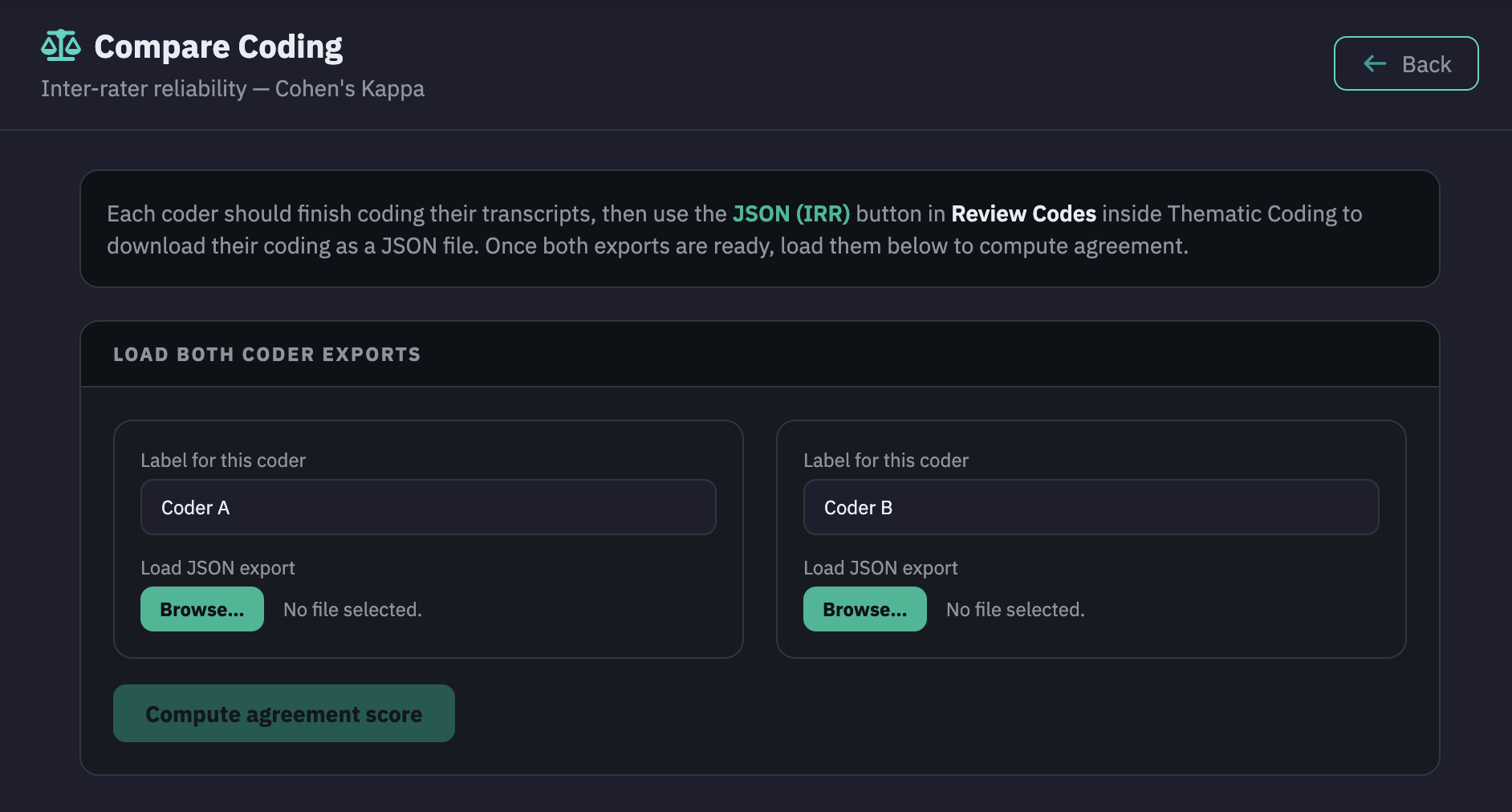
- Open Compare Coding from qualitative moduleCompare Coding is a standalone module accessible directly from the qualitative module cards. It does not require transcripts to be loaded. Make sure both coders' files are available in the same computer.
- Load both export filesUpload each coder's JSON file and give each a label (e.g. the coder's name or initials). The labels appear in the results table.
- Click Compute agreement scoreAnalyZ Solutions compares the two files segment by segment, calculates Cohen's Kappa for each code individually, and computes a macro-average Kappa across all codes.
Watch a quick demonstration of comparing coding done by two coders in AnalyZ Solutions
04Reading the results
The results screen shows:
- Overall Kappa (macro-average): the average Kappa across all codes. This is the headline figure, but individual code Kappas are usually more informative.
- Per-code Kappa: a bar showing each code's Kappa and its strength label. This immediately identifies which codes are driving any disagreement.
- Percentage agreement: the raw proportion of segments where both coders agreed, shown alongside Kappa. Useful for context: a code with only 3 segments may show 100% agreement but the Kappa is not meaningful at that sample size.
The interpretation panel below the results classifies each code as strong (κ ≥ 0.80), acceptable (0.60–0.79), or below threshold (κ < 0.60), and provides specific next steps for each category.
05What to do when agreement is low
Low Kappa for a specific code almost always traces back to one of three causes: the code definition is ambiguous, the coders understood the definition differently, or the code is genuinely difficult to apply consistently to this type of data.
- Compare the two coders' segments side by side
Export both files and look at which passages one coder coded that the other did not. Look for a pattern: is one coder coding more broadly? More narrowly? Using the code for a different type of passage? - Discuss the disagreements
Bring the disagreeing passages to a calibration session. For each passage, each coder explains why they made the decision they did. These conversations almost always surface the implicit difference in understanding. - Revise the code definition
Update the code description and analytical memo to reflect the agreed definition. Add concrete examples of what qualifies and what does not. Make the boundary cases explicit. - Recode a subset of transcripts
After calibration, have both coders independently recode two or three transcripts using the revised definition. Re-export and re-compute Kappa to confirm improvement before recoding the full dataset.
06When to use IRR and when it is not required
IRR is most important in studies where:
- Two or more researchers are contributing to the coding and analysis
- The findings will be peer-reviewed or published
- The coding framework will be applied to additional data in the future
- The study makes strong causal or prevalence claims based on coded data
Single-researcher studies, which are common in applied evaluation, can report rigour through other means: transparent codebook documentation, analytical memos, member checking, and reflexivity statements. IRR is a tool for demonstrating consistency between coders, not the only marker of rigour in qualitative research. Whether the coding is complete enough to stop is a separate question, covered in thematic saturation.
Do both coders need to code all transcripts, or only a subset?
What if two codes consistently co-occur in one coder's data but not the other's?
Can I report percentage agreement instead of Kappa?
My two coders have very different levels of experience. Does that affect Kappa?
What does it mean if Kappa is high but the two coders coded very different numbers of segments?
A code shows high percentage agreement but Kappa of 0.00. What does that mean?
Is it acceptable to remove a code with low Kappa from the analysis?
How do I report Kappa in a research report or paper?
What is the difference between Cohen's Kappa and weighted Kappa?
We reached high Kappa on a subset. Do we need to verify on the full dataset?
Compare your coding in AnalyZ Solutions
Export your coding from Thematic Coding and calculate Kappa in minutes.
Get started