How to develop thematic codes for qualitative research
Coding is the engine of qualitative analysis. This guide covers what codes are and why they matter, how your analytical approach shapes the codes you create, how to build a rigorous codebook, and how to assign and review codes in AnalyZ Solutions.
01Why coding is the foundation of qualitative analysis
Qualitative data arrives as language: thousands of words spoken by participants in interviews, written in field notes, or captured in open-ended survey responses. Before any pattern can be identified, any comparison made, or any finding reported, that language must be organised. Coding is how that organisation happens.
A code is a short label applied to a passage of text that captures what is happening in that passage. Codes transform unstructured language into a structured dataset of labelled excerpts that can be sorted, counted, compared, and queried. Without coding, a set of transcripts is just text. With a well-developed codebook applied consistently, it becomes evidence.
Consider a study of barriers to healthcare access with twelve participants. One participant says: "I knew the clinic existed, but I had no idea what documents I needed to bring or whether I would be turned away." Another says: "Nobody explained the process to me. I showed up and was sent home." Both passages describe different surface experiences, but a code like "Lack of procedural information" captures what they share. Applied consistently across all twelve transcripts, that code produces a retrievable body of evidence on a specific barrier.
Coding also creates an audit trail. A well-documented codebook with definitions, analytical memos, and examples produces a transparent record of the analytical decisions that led to the findings. That transparency is one of the primary bases for claiming rigour in qualitative research.
02How codes become findings
Codes are not findings in themselves. A finding emerges when coded excerpts are read, compared, and interpreted in relation to the research question.
Retrieval: all segments assigned to a code are read together. This lets the researcher examine the full body of evidence on a theme across all participants and see variation within it.
Within-code variation: even within a single code, passages vary. Some participants express a theme with urgency; others mention it in passing. Reading all segments together reveals the internal texture of a theme and prevents the researcher from treating a single vivid quote as representative.
Cross-code relationships: findings often emerge from the relationship between codes. A researcher might notice that "Lack of procedural information" frequently appears alongside "Previous negative experience" in the same segments, suggesting a compound barrier that is more than the sum of its parts.
Interpretation: the researcher brings theoretical knowledge and contextual understanding to the coded excerpts and argues for what the pattern means. Codes organise the evidence; the researcher makes the argument.
03What makes a good code
Descriptive rather than evaluative. A code should describe what is happening in the passage, not judge it. "Perceived barriers to uptake" is descriptive. "Failure to engage" imports the researcher's assessment. Descriptive codes stay close to what participants actually said.
Mutually distinct. Each code should capture something different from every other. If two codes frequently appear on the same passage and you cannot articulate the difference between them, they likely represent a single idea and should be merged.
Consistently applicable. A code should be applicable across all transcripts and by any researcher working with the data. Write a definition for every code before you begin coding.
Grounded in the data. Where possible, use participant language in code names. A code called "Sending the child away" (drawn from participants' own words) is more grounded than "Temporary separation strategy."
04How your analytical approach shapes your codes
The codes you create and how you create them should reflect the analytical approach your research design requires. A thematic analysis coded inductively will produce a different codebook than a framework analysis coded deductively from the same data, even when both are conducted rigorously.
Inductive coding
In inductive coding, codes emerge from the data. The researcher reads through transcripts without a predetermined framework and creates codes as new ideas and patterns become visible. The process is iterative: early codes are often refined or renamed as more of the data is read.
Inductive coding is suited to exploratory research where no adequate theoretical framework exists, or where the researcher wants to ensure participants' own categories drive the analysis. It is common in grounded theory and in the early stages of thematic analysis.
The risk is drift: without a fixed framework, the researcher may code inconsistently across transcripts. Frequent review of the codebook and early passages is essential.
Deductive coding
In deductive coding, the codebook is developed before coding begins, based on a theoretical framework, a programme theory of change, or a set of research questions. The researcher reads through the transcripts looking for evidence of each pre-defined code.
Deductive coding is well suited to evaluation research, where the questions are fixed in advance. It is also more reliable across multiple coders because definitions are established before any coding begins. The risk is closure: passages that do not fit the predetermined codes may be overlooked.
Hybrid coding (most common in practice)
Most applied qualitative research uses a hybrid approach: a starting set of deductive codes from the research questions, supplemented by inductive codes that emerge during analysis. The deductive codes provide structure; the inductive codes capture what the framework did not anticipate.
An evaluation of a maternal health programme might begin with deductive codes for each component of the programme theory: "Awareness of services", "Access to services", "Quality of care". During coding, the researcher repeatedly encounters passages about husbands' involvement in healthcare decisions, which was not in the original framework. An inductive code "Spousal influence on health decisions" is added. At the end of analysis, that inductive code is one of the most significant findings.
05Building a codebook
A codebook is a structured document that defines every code used in the analysis. It is the single most important safeguard for analytical consistency, and the primary evidence that the analysis was conducted systematically rather than impressionistically.
Each entry should include: a code name; a definition of one to three sentences; inclusion criteria (what qualifies as a passage for this code); exclusion criteria (what should not be coded here, especially passages easily confused with this code); one or two example passages from the data; and an analytical memo recording the code's theoretical significance and how it developed.
As a concrete example, a code called "Cost as a barrier" in a healthcare access study might be defined as: "Any passage in which a participant identifies financial cost as a reason for not seeking, accessing, or continuing with healthcare. Includes direct costs (fees, medicines, transport) and indirect costs (lost income, childcare). Does not include passages where cost is mentioned in passing without being identified as a barrier." An example passage: "I would have gone to the doctor but the consultation fee alone would have taken a week's wages."
06How to build and manage your codebook in AnalyZ Solutions
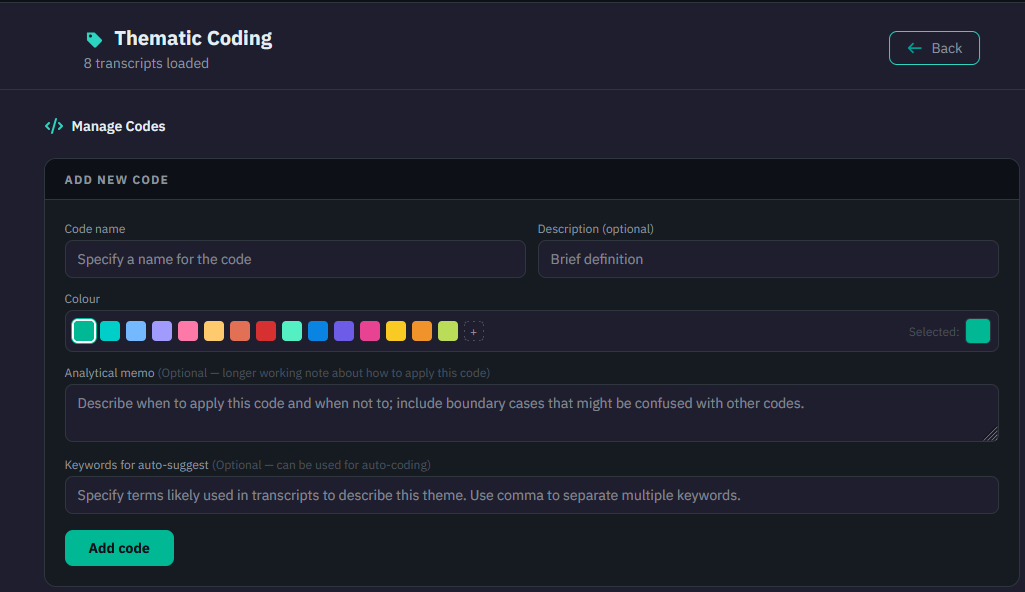
Open Thematic Coding from the qualitative home page and select Manage Codes. This is where you create and maintain your codebook throughout the analysis.
For each code, enter a name, a description (the definition), an analytical memo, keywords for auto-suggest, and a colour. Colours distinguish codes in the transcript view, coding stripes, and analysis charts. To edit an existing code, click the edit button on any code card. Changes to the definition apply immediately across all segments, so update the analytical memo with a dated note whenever you revise a definition mid-analysis.
07How to assign codes to transcript segments in AnalyZ Solutions
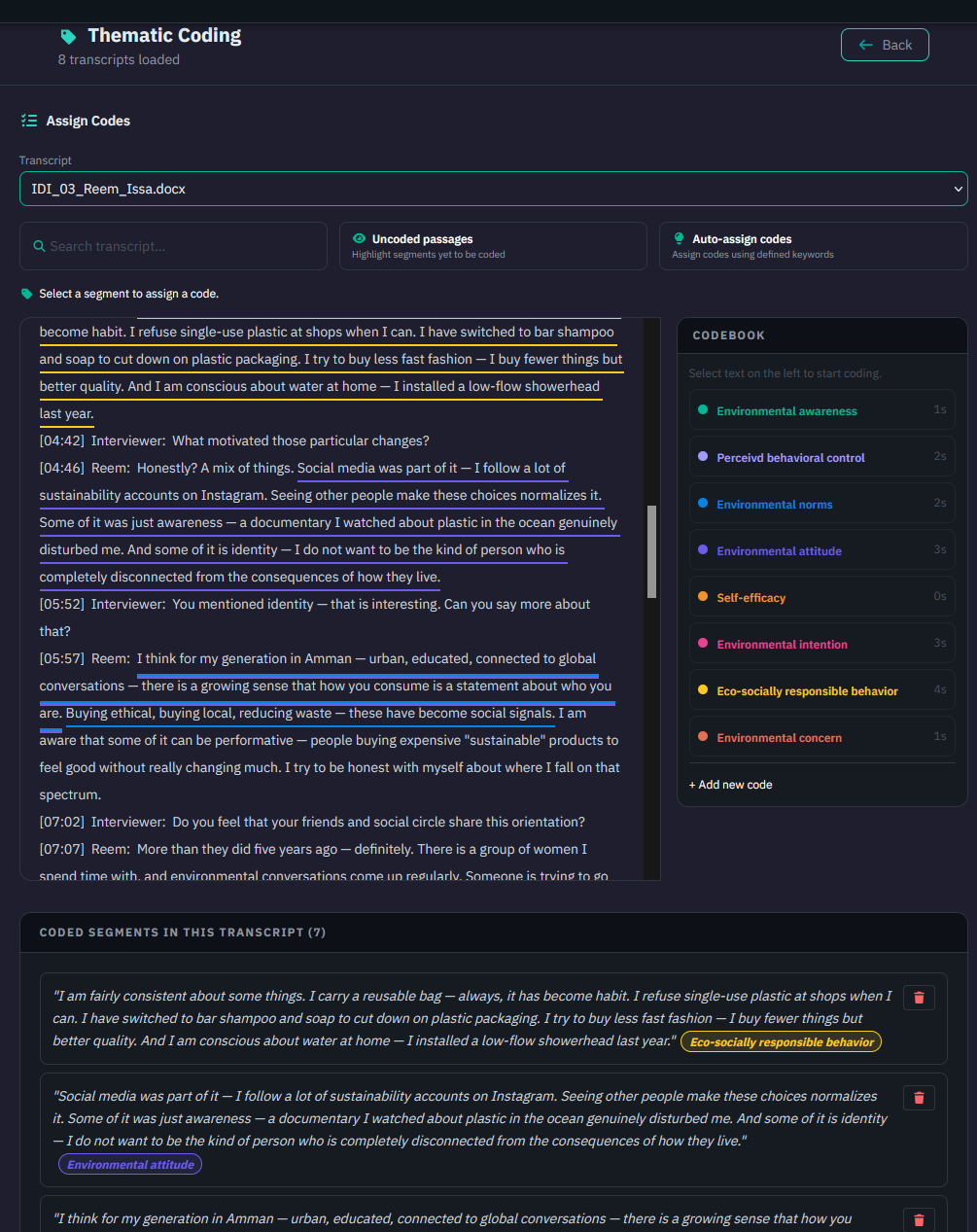
Select Assign Codes from the Thematic Coding cards. The screen shows a transcript on the left and the codebook panel on the right.
- Read the transcript before coding it
Read through each new transcript once without coding. Take note of what is relevant, surprising, or unclear. This reading pass reduces over-coding and gives you a sense of the transcript's overall shape before labelling individual passages. - Select a passage
Click and drag to highlight the text you want to code. Choose the unit that captures one complete thought or experience. A passage addressing two separate themes should usually be split into two shorter segments. - Click a code in the codebook panel
With text selected, click the code name. The segment is saved immediately. The passage receives a coloured underline in the transcript view. Coding stripes in the right margin show coding density: bright sections have been coded; dark sections have not. - Assign multiple codes if needed
Keep the selection active and click additional codes. For example, a passage reading "I heard about the programme from a neighbour, and I worried it would cost too much" might receive both "Source of programme awareness" and "Cost as a barrier." - Remove a misapplied code
Already-assigned codes show a small badge at the top-right corner. Click the badge to remove that code from the segment without affecting other codes on the same passage. - Use keyword auto-suggest
Click Auto-assign codes in the toolbar. AnalyZ Solutions scans the transcript for the keywords defined in each code and generates suggestions for review. Always review auto-suggestions before accepting: keyword matching finds passages containing your terms but cannot assess relevance in context.
Watch a quick demonstration of developing and assigning codes in AnalyZ Solutions
08Reviewing coded segments
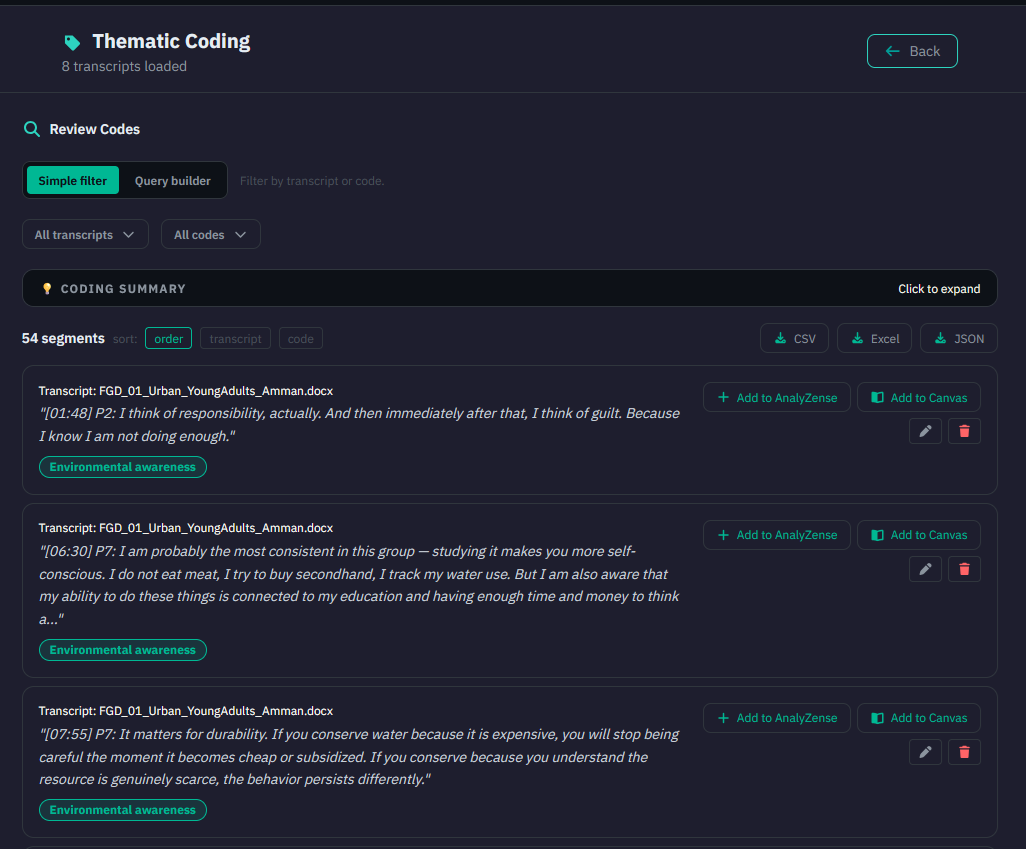
Select Review Codes to audit your coding at any point. Two filter modes are available.
Simple filter: use the transcript and code dropdowns to restrict the segment list. Filtering by a single code and reading all its segments together is the most direct way to assess whether the code has been applied consistently.
Query builder: build Boolean retrieval conditions across codes. AND returns segments coded with both Code A and Code B simultaneously. OR returns segments carrying either code. NOT returns segments with Code A but not Code B. For example: a researcher wants to find all passages about nutrition knowledge that do not also mention food insecurity, to examine knowledge themes separately from access barriers. She builds the query "Nutrition knowledge" NOT "Food insecurity."
09A note on inter-rater reliability
When more than one researcher is coding the same transcripts, consistency between coders is a quality concern that needs to be addressed systematically. Two researchers applying the same codebook will not always code the same passages or apply the same code to passages they both identify as relevant.
The standard approach is to have both researchers independently code the same subset of transcripts, calculate Cohen's Kappa to measure agreement, and hold a calibration session to discuss and resolve disagreements before coding the remaining data. A Kappa of 0.60 or above is the widely accepted minimum for qualitative research.
AnalyZ Solutions supports this through the Compare Coding module. Each coder exports their coding as a JSON file from Review Codes; those files are loaded into Compare Coding, which calculates Kappa overall and per code. See How to calculate inter-rater reliability for the full process.
10Common mistakes to avoid
- Coding too broadly. A code called "Challenges" containing passages about financial barriers, distance, cultural stigma, and bureaucratic complexity is analytically useless. Split it into specific codes.
- Coding too narrowly. If "worried about the cost", "concerned about fees", and "cannot afford it" are each receiving separate codes, they should be merged under "Cost as a barrier."
- Changing code definitions without recoding earlier transcripts. When a definition changes, go back to already-coded transcripts and verify earlier passages still fit the revised definition.
- Skipping the analytical memo. The memo captures your thinking about what the code means and how it developed. Researchers who skip memos often struggle during write-up to articulate what a theme actually means.
- Treating frequency as importance. A code appearing in every transcript is not necessarily more significant than one appearing in two. A theme raised briefly by many participants may matter less than one explored at length by a few.
How many codes should I have in my codebook?
Should I code the interviewer's speech as well as the participant's?
Can the same passage receive more than one code?
When should I add a new code mid-analysis?
My colleague and I are reaching different codes. Is that a problem?
How do I decide whether two codes should be merged or kept separate?
Is there a difference between a code and a category?
How detailed should my code definitions be?
Should I develop my codebook before or after reading the transcripts?
What is the difference between descriptive and interpretive coding?
How should I handle a passage that contradicts my emerging themes?
Can I code data from different sources, such as interviews and documents, using the same codebook?
How do I know when my coding is finished?
Start developing your codebook and assign them to transcripts
Open Thematic Coding in AnalyZ Solutions and begin building your codes. Free to sign up, free to analyze.
Get started